


Introduction
Life Together is a single-player narrative social simulation game that places you in a compact shared apartment where every decision reshapes household dynamics and personal relationships. This editorial overview explains how Life Together blends choice-driven social mechanics with episodic outings, describing the gameplay loop, controls, progression, visual approach, customization options, accessibility features, challenge systems, and offline behavior so you know what to expect before downloading.
Gameplay mechanics
At its core, Life Together focuses on interpersonal decision-making inside a small living space. Players manage daily routines, negotiate limited resources like bathroom time and cooking slots, and steer conversations that influence trust and mood among housemates. Choices operate on two layers: scripted narrative beats that advance character arcs and unscripted ripple effects that create emergent conflicts or cooperative opportunities. Periodic adventure segments transport the protagonist to short, self-contained locations such as a market, a workplace, or a park where new characters and episodic dilemmas introduce consequences that flow back into apartment life. The result is a steady cadence of compact domestic scenes interleaved with brief excursions that refresh context without breaking the simulation feel.
Controls and user interface
Life Together is designed for touch-first mobile play with an interface that keeps interactions intuitive and focused. Tap to select dialogue options or perform actions, long-press to reveal contextual details about items or character states, and use menus to inspect schedules, relationship meters, and pending events. Tooltips explain the immediate and longer-term implications of decisions so you can weigh trade-offs without losing immersion. The UI emphasizes clarity: distinct icons for routines, visible tension indicators, and a simple calendar view for planning help you make informed choices without complex input sequences.
Progression and replay value
Progression in Life Together is narrative and relational rather than level-based. Advancing through episodes, resolving domestic conflicts, and building trust unlocks branching story paths, character backstories, and variations on daily routines. Because decisions can permanently alter future options, different leadership approaches—supportive, authoritarian, or mixed—lead to distinct outcomes and unlockable scenes. This branching structure encourages multiple playthroughs to discover alternate endings and hidden interactions, with replay value driven by experimenting with interpersonal strategies and observing how small behavioral changes echo over simulated weeks.
Visual style and level structure
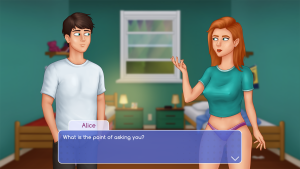
The visual presentation favors close framing and character-focused scenes that keep the apartment feeling intimate. Portrait art and expressive character poses emphasize mood and tension, while adventure segments introduce wider backdrops and brief shifts in palette to signal a change of scene. The game is organized into chapters or episodes that alternate between routine apartment management and compact outings, which helps maintain steady pacing: domestic scenes concentrate on micro-decisions and timing, while excursions provide narrative beats that broaden context and introduce new stakes.
Customization and player expression
Instead of extensive cosmetic systems, customization in Life Together is expressed through routines and social strategies. You shape the household by assigning chores, adjusting schedules, choosing conflict responses, and prioritizing which relationships to invest in. These choices represent player identity through behavior—delegation, mediation, or strict enforcement—so your leadership style becomes visible in how the household runs and in resulting story outcomes rather than through large visual edits.
Challenge systems and difficulty
Challenges arise organically from scarcity of space, overlapping schedules, and competing needs. Simultaneous events and interpersonal crises force triage decisions that affect mood and trust. A visible tension or stress meter tracks household strain and serves as an early warning for potential breakdowns, encouraging planning and cooperation. Difficulty is partly player-directed: choosing to micromanage or to let routines run loosely changes how tight the simulation feels. The game rewards anticipatory planning and thoughtful prioritization rather than reflex-based inputs.
User experience and accessibility
The design emphasizes legible text, clear visual cues for character states, and an uncluttered HUD to make decisions straightforward. Accessibility features include adjustable text size, high-contrast UI options, and optional hints that can be toggled on for guidance. A relaxed mode reduces time pressure for players who prefer a less demanding pace, while skip options let you bypass minor interactions to speed through familiar segments. These choices make the experience adaptable to different play styles and needs.
Offline play and performance
Life Together is a single-player experience that runs offline after download, so you can play on commutes or in low-connectivity situations without persistent internet access. The build is optimized for smooth animations and responsive input across a range of devices, with performance improvements aimed at maintaining stable frame pacing during scenes with multiple concurrent characters and events.
Version information
The current release, New Version 0.4 + INC Patch, focuses on stability fixes, clearer relationship indicators in the UI, and refinements to adventure pacing to reduce repetitive sequences while preserving meaningful outcomes. These updates improve clarity and reliability so the social simulation remains readable and engaging over repeated playthroughs.
- No virus
- No advertising
- User protection
Information
- File size: 736.00 M
- Language: English
- Latest Version: 0.4
- Requirements: Android
- Votes: 284
- Package ID: com.game.life.together
- Developer: Mr. BlackEyes
Screenshots



















Explore More
Experience nonstop thrills with our newest edge-of-your-seat action game! With console-quality graphics and intuitive touchscreen controls, you'll be drawn into high-octane combat and stunt-driven gameplay. Choose from an arsenal of upgradable weapons and vehicles to blaze through enemy bases, post-apocalyptic cities, and more. Physics-based action packed with explosions and destructible environments make every level more intense than the last.

RVIP1

Night with Timber

Kingdom of Velvet Сhains

View of Family Resurrected

INA858

3 Days to Live

Its You Again and Again

Hucow Tiffany's First Milking